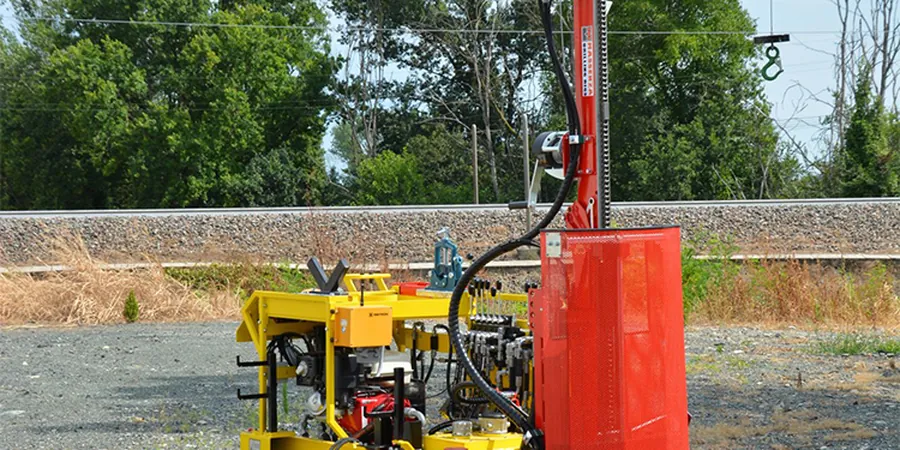
Tulsa sits on a patchwork of lean clays, sandy silts, and the occasional ancient river terrace left by the Arkansas River. That variability punishes generic foundation assumptions. A Standard Penetration Test here isn't a checkbox—it's the primary method to quantify how dense or stiff each stratum actually is before a single footing gets poured. Midtown's weathered shale can yield N-values above 40 within ten feet, while the looser alluvial pockets near the river often struggle to reach N=8. Our SPT program follows ASTM D1586-18, using an automatic trip hammer with calibrated energy ratio to deliver split-spoon samples that feed both the grain-size lab analysis and the site-specific bearing capacity models. With summer surface temps pushing 105°F and clay heave cycles driven by the city's 42-inch average annual rainfall, reliable blow-count data stops project surprises dead in their tracks.
Tulsa's soil profile can shift from stiff shale to loose river sand within a single city block—SPT blow counts catch that transition before the excavator does.
Methodology and scope
Local considerations
A four-story mixed-use project near Cherry Street hit refusal unexpectedly at 12 feet. The contractor assumed weathered shale. The SPT blow counts told a different story: N-values jumped from 22 to 85 in one 6-inch drive, indicating a hard sandstone lens—not shale—with a steep dip. Attempting drilled shafts without that data would have burned weeks in tooling changes. We've seen similar surprises north of downtown where old channel-fill deposits hide cobble-sized gravel that the standard split spoon can't penetrate. The risk isn't just refusal; it's misclassifying a bearing layer that settles differentially when loaded. Tulsa's expansive clays add another layer: SPT data alone won't predict heave, but the sample recovery lets our lab run Atterberg limits and identify the PI values that signal trouble. Correlating blow counts with lab index properties builds a defensible foundation recommendation, not a guess.
Applicable standards
ASTM D1586-18: Standard Test Method for Standard Penetration Test (SPT), ASTM D4633: Energy Measurement for SPT Hammer, ASTM D2487: Unified Soil Classification System (USCS), ASCE 7 Chapter 20: Site Classification Procedure, IBC 2021 Section 1803: Geotechnical Investigations
Associated technical services
Foundation SPT Borings
Vertical borings at planned footing locations to generate N-value profiles for shallow and deep foundation design. Includes split-spoon sampling and USCS field classification.
Liquefaction Screening
SPT-based liquefaction potential evaluation using NCEER/Youd-Idriss methodology. Corrected N1(60) values plotted against site-specific seismic demand per ASCE 7.
Pavement Subgrade Investigation
Shallow SPT borings to 10–15 feet for flexible and rigid pavement design. Blow counts correlate with CBR values for Tulsa's commercial parking and roadway projects.
Deep Boring & Rock Coring
Extended SPT borings past 50 feet with NQ rock coring upon refusal. Applied for tall structures and bridge foundations where bedrock competency must be verified.
Typical parameters
Frequently asked questions
How much does an SPT boring program cost in Tulsa?
Typical SPT investigation budgets in Tulsa range from US$580 to US$790 per boring for depths up to 30 feet, including mobilization, drilling, split-spoon sampling, field logging, and a signed boring log report. Deeper borings, rock coring, or sites requiring traffic control add to the base cost. A standard residential lot with two borings generally falls at the lower end of that range.
How many SPT borings does IBC require for a commercial building?
IBC 2021 Section 1803 requires a minimum of one boring for every 2,500 square feet of building footprint for structures up to three stories. Taller buildings or sites with erratic geology need more. Tulsa's combination of alluvial and residual soils often warrants tighter spacing—we typically recommend borings at each corner plus one in the center for irregular footprints.
What is the difference between N-value and N60?
N-value is the raw blow count from the field. N60 corrects that number to a standard 60% hammer energy efficiency. Older safety hammers can deliver as little as 45% energy, producing artificially high blow counts. Our automatic trip hammers are calibrated to deliver at least 60% energy, and we still apply the correction per ASTM D4633 to ensure the data is comparable across rigs and projects.
Can SPT borings identify expansive clay in Tulsa?
SPT blow counts alone do not measure expansion potential, but the split-spoon samples we recover are suitable for Atterberg limits testing. A liquid limit above 50 and plasticity index exceeding 25 indicate highly expansive clay, common in Tulsa's residual shale-derived soils. We routinely send selected samples to the lab when the field log identifies fat clay with visible slickensides.
How deep do you drill for a typical Tulsa SPT investigation?
Most commercial projects in Tulsa require borings to 30 or 40 feet, penetrating through the active clay zone and into competent shale or dense alluvium. Single-story residential investigations may stop at 20 feet if refusal is encountered. We extend depth when liquefaction assessment is required, as the critical granular layers often sit between 15 and 35 feet in the Arkansas River corridor.