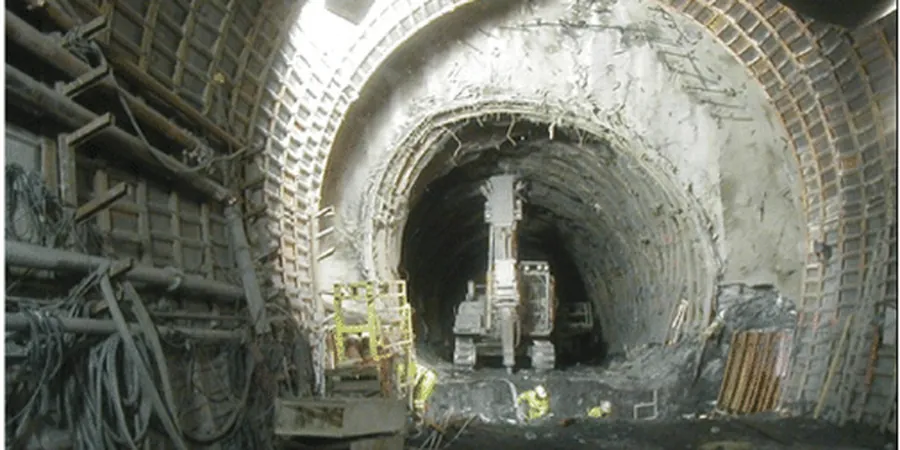
Tulsa's subsurface tells a story carved by the Arkansas River — deep alluvial deposits, pockets of fat clay, and weathered shale that can cripple a tunnel drive without warning. Much of the city sits on Quaternary terrace deposits over Pennsylvanian bedrock, a sequence that demands careful geotechnical analysis for soft soil tunnels before the first cut. We run in-situ testing programs that map the transition zones between stiff overconsolidated clays and loose silty sands, because that boundary is where face instability and excessive settlement often begin. A CPT test provides a nearly continuous profile of tip resistance and pore pressure, helping us identify thin drainage layers that conventional borings can miss along a planned alignment.
In Tulsa's alluvial corridor, the difference between a successful drive and a collapse is often a 12-inch seam of loose sand that nobody found during the desk study.
Methodology and scope
Key characterization steps we execute on every soft-ground tunnel project include:
- Continuous SPT or CPT profiling at intervals no greater than 5 feet vertically across the tunnel horizon
- Laboratory index testing — grain size distribution per ASTM D6913, Atterberg limits per ASTM D4318 — on every distinct stratum
- Consolidation and undrained triaxial (ASTM D4767) testing on soft clay samples to define strength envelopes and pore pressure response
- Permeability assessment via falling-head tests in boreholes or CPT dissipation tests when groundwater control is critical
- Geophysical cross-hole or downhole surveys where boulder beds or karstic limestone lenses are suspected
Local considerations
The most common mistake we see in Tulsa is designing a tunnel support pressure based on average undrained shear strength without checking for sand stringers. Even a six-inch layer of clean sand can act as a drain, lowering effective stress at the face until the clay matrix loses arching capacity and the heading collapses. In the Cherry Street corridor, where old channel deposits cut across the alignment, we have documented Su values that drop from 900 psf to under 400 psf over less than 20 linear feet. A second failure mode is long-term consolidation settlement beneath existing utilities — soft clay beneath a tunnel invert can keep compressing for months after the lining is placed if the ground model underestimated the compressible thickness. We run one-dimensional consolidation tests (ASTM D2435) specifically to quantify that risk before the TBM launch pit is excavated.
Applicable standards
ASTM D1586-18 Standard Test Method for Standard Penetration Test (SPT), ASTM D4767-11 Standard Test Method for Consolidated Undrained Triaxial Compression Test for Cohesive Soils, ASTM D2487-17 Standard Practice for Classification of Soils for Engineering Purposes (Unified Soil Classification System), IBC Chapter 18 Soils and Foundations (2021 Edition), ASCE 7-22 Minimum Design Loads — Section 11 Seismic Design (for liquefaction screening)
Associated technical services
Tunnel Alignment Geotechnical Baseline Report
Full corridor investigation combing SPT borings, CPT soundings, and laboratory strength/consolidation testing to produce a GBR compliant with the recommendations of the International Tunneling Association. Covers face stability analysis, groundwater control requirements, and anticipated ground behavior class for each 100-foot reach.
Face Stability and Settlement Modeling
Numerical analysis using finite-element or finite-difference codes calibrated to Tulsa alluvial soil parameters. We model staged excavation, face support pressure, and surface settlement trough development to set trigger levels for instrumentation and contingency grouting.
Pre-Excavation Grouting and Ground Improvement Design
Where sand lenses or soft clay pockets create unacceptable risk, we design permeation or jet grouting programs verified by post-treatment permeability testing. Our approach targets the specific problematic zones identified during the site investigation rather than applying blanket treatment across the full alignment.
Typical parameters
Frequently asked questions
What makes Tulsa soft-ground tunneling different from tunneling in stiff clay or rock?
Tulsa's near-surface geology along the Arkansas River corridor is dominated by Quaternary alluvium — interbedded clays, silts, and sands — over weathered Pennsylvanian shale. The clays often have low undrained shear strength (Su 300–1,200 psf) and the sands can be loose and water-bearing. This combination creates face stability challenges, requires careful groundwater control, and demands a ground model with much finer stratigraphic detail than a rock tunnel would need.
Which laboratory tests are most critical for soft-ground tunnel design in this region?
Consolidated undrained triaxial tests (ASTM D4767) on undisturbed Shelby tube samples give us the effective stress strength envelope that governs face stability. One-dimensional consolidation tests (ASTM D2435) quantify the magnitude and rate of settlement above the tunnel. Grain size distributions (ASTM D6913) and Atterberg limits (ASTM D4318) classify each stratum and help predict behavior during excavation and groundwater control.
How deep do you typically investigate for a tunnel alignment in Tulsa?
We follow the common guideline of investigating to a depth of at least 1.5 to 2 times the tunnel diameter below the invert. For a 10-foot diameter soft-ground tunnel at 30 feet depth, that means borings extending to roughly 45–55 feet below ground surface. Deeper investigation is warranted when compressible clay layers extend beyond that depth and could contribute to long-term settlement.
How much does a geotechnical investigation for a soft-ground tunnel in Tulsa cost?
A soft-ground tunnel investigation in Tulsa typically ranges from US$3,610 to US$17,200 depending on alignment length, number of borings, laboratory testing scope, and whether geophysical methods are included. A short utility tunnel with two borings and basic index testing falls at the lower end, while a full corridor GBR with CPT, triaxial, and consolidation testing for a longer alignment reaches the upper range.
How long does the field and lab work take before we receive the final report?
Field drilling and in-situ testing typically require 3 to 8 working days depending on the number of boreholes and access conditions. Standard laboratory index tests add 5 to 7 business days; consolidation and triaxial tests extend the timeline by 2 to 3 weeks due to the time-dependent nature of the procedures. The draft geotechnical baseline report is usually delivered within 4 to 5 weeks of completing fieldwork.