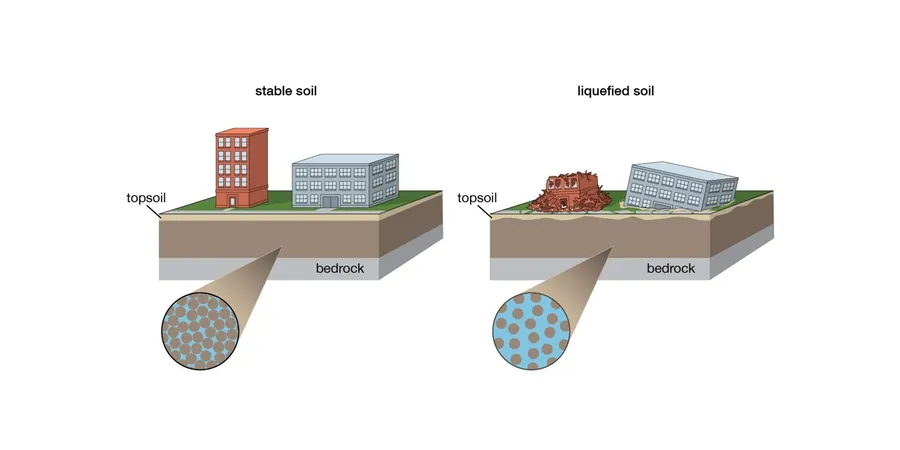
Tulsa's skyline tells a story of booms, busts, and resilience. From the Art Deco towers raised during the 1920s oil rush to the modern infill reshaping the Pearl District, each project rests on a complex sedimentary legacy. The Arkansas River has spent millennia depositing loose sands and silts across the floodplain, materials that behave predictably under static loads but can lose all strength during a seismic event. A proper soil liquefaction analysis is not a bureaucratic checkbox for this city. It is a direct examination of whether the ground beneath a structure will turn to a slurry when shaken. Our work begins with SPT drilling or CPT soundings to extract the exact data needed for a site-specific assessment.
Liquefaction doesn't require a massive earthquake. Moderate shaking can trigger it if the soil profile is loose, saturated, and granular.
Methodology and scope
Local considerations
Tulsa sits at an elevation of roughly 720 feet, far from any plate boundary, yet the ground here has a memory. The 2011 Prague earthquake, a magnitude 5.7 event centered 50 miles away, sent sharp jolts through downtown high-rises and cracked masonry in older neighborhoods. That event reminded local engineers that induced seismicity and distant ruptures can still generate acceleration levels that challenge loose alluvial soils. The consequence of skipping a liquefaction study is not just cracking; it is total bearing capacity loss under footings, flotation of buried tanks, and lateral spreading toward the river channel. Municipal plan reviewers now routinely ask for a site-specific analysis on any project classified as Seismic Design Category C or higher, especially on sites east of the river where the water table sits within 10 feet of the surface.
Applicable standards
IBC 2021 Section 1803.5.12 (Seismic Design Category D-F sites), ASCE/SEI 7-22 Chapter 11 & 20 (Site Classification and Liquefaction), ASTM D1586-18 (Standard Penetration Test), ASTM D5778-20 (Electronic Friction Cone and Piezocone Testing), NCEER Workshop Report (Youd & Idriss 2001) — Standard of Practice
Associated technical services
SPT-Based Liquefaction Screening
We use ASTM D1586 drilling methods to recover split-spoon samples and measure blow counts. Cyclic resistance ratios are computed using Seed-Idriss simplified procedure.
CPT Pore Pressure Profiling
A digital cone penetrometer captures continuous tip resistance and sleeve friction. We evaluate the Soil Behavior Type Index and generate near-real-time liquefaction potential charts.
Post-Liquefaction Settlement & Lateral Spread Analysis
Using the site-specific CSR and SPT/CPT data, we calculate expected vertical settlement and horizontal displacement to inform foundation design decisions.
Typical parameters
Frequently asked questions
Does Tulsa really have a liquefaction risk given its distance from major fault lines?
Yes. The 2011 Prague earthquake demonstrated that seismic energy travels efficiently through the region's geology. Loose, saturated sands along the Arkansas River corridor are susceptible even to moderate shaking. The IBC requires evaluation for structures in higher seismic design categories regardless of perceived local risk.
What does a soil liquefaction analysis typically cost for a commercial lot in Tulsa?
For a standard commercial site in Tulsa, the field investigation combined with the liquefaction analysis report generally ranges from US$2,630 to US$3,880. The final cost depends on the depth of the investigation and the number of SPT borings or CPT soundings required to characterize the site.
How do you determine if the soil will actually settle after an earthquake?
We correlate the factor of safety against liquefaction with volumetric strain. Using published relationships by Zhang, Robertson, and Brachman, we compute a post-shaking settlement profile. This tells the structural engineer exactly how much vertical movement to expect, allowing them to design a foundation that tolerates or bypasses those strains.