A rigid inclinometer casing extends down through the weathered shale, recording lateral deflection at half-meter intervals while a total station tracks surface movement from a fixed benchmark across the street. This is the kind of instrumentation our team deploys when designing a retaining wall in Tulsa, where the Pennsylvanian-age bedrock can weather into a slick, plastic clay that creeps imperceptibly under sustained load. The city sits at roughly 220 m elevation along the Arkansas River, and the valley terraces present a mix of stiff overconsolidated clay and intermittent sandstone lenses that demand a layered analytical approach. Before finalizing a wall cross-section, we often correlate the deflection data with a slope stability back-analysis to confirm that the assumed failure surface matches what the inclinometer actually records at depth, which is especially critical on the wooded bluffs overlooking the river.
In Tulsa, the swelling pressure of a wet clay seam can exceed 100 kPa against the back of a wall — a load case that standard earth pressure theory never predicts.
Methodology and scope
Local considerations
The contrast between Tulsa's hot, humid summers and the occasional deep freeze of a January ice storm creates a wet-dry cycling that accelerates degradation of clay-shale backslopes. When a wall is built into a cut along the Osage County line, the exposed shale face can slake within a single winter, reducing the passive resistance in front of the toe by half. That loss of passive wedge is what we model explicitly in our deep excavation analysis when the wall forms part of a basement or depressed driveway. Another risk that surfaces in older Tulsa neighborhoods like Maple Ridge is the presence of undocumented fill from the 1920s oil-boom construction era; this fill often contains brick bats, cinder, and even buried timber that rots out over decades, creating voids behind the wall that concentrate water and trigger localized collapse. A thorough test-pit program down to undisturbed material is the only reliable way to catch these legacy conditions before they turn into a retaining wall failure that takes out a neighboring property line.
Applicable standards
IBC 2021 (International Building Code), ASCE 7-22 Minimum Design Loads for Buildings, ASTM D1586-18 Standard Penetration Test, ASTM D2487-17e1 Unified Soil Classification, AASHTO LRFD Bridge Design Specifications, 9th Ed. (for MSE walls in public ROW)
Associated technical services
Subsurface Investigation for Wall Alignment
Rotary-wash borings and test pits along the proposed wall footprint to map the contact between residual clay and weathered bedrock, logged in accordance with ASTM D2488 and supplemented with pocket penetrometer and torvane readings at each change of stratum.
Geotechnical Design Report with Wall Cross-Sections
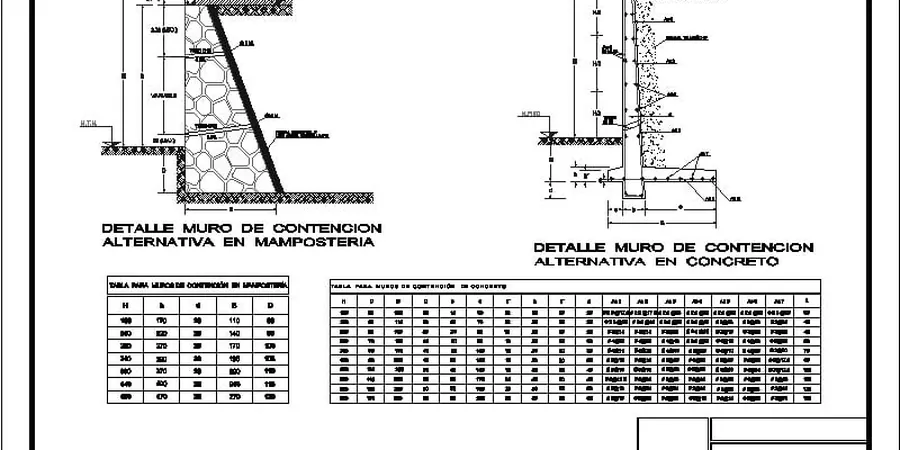
A stamped report including external stability calculations (sliding, overturning, bearing), global slope stability output, and recommended stem and footing dimensions for cantilever, counterfort, or MSE alternatives, referencing Tulsa County grading permit requirements.
Drainage System Design and Backfill Specification
Detailed drainage schematics showing chimney drains, toe drains, and outlet spacing; backfill material specification per ASTM D2434 with gradation bands that prevent fines migration from the retained soil into the drainage layer.
Construction Observation and Wall Monitoring
Periodic site visits during excavation, rebar placement, and backfill compaction, plus post-construction inclinometer or survey-monument readings over two seasonal cycles to confirm that the wall performance matches the design assumptions.
Typical parameters
Frequently asked questions
What does a retaining wall design cost for a residential lot in Tulsa?
For a typical residential retaining wall in Tulsa, the geotechnical investigation and design report generally ranges from US$1,130 to US$3,720, depending on wall height, access constraints, and the number of borings required. A simple 1.2 m garden wall on a flat lot falls at the lower end, while a 3 m wall along a steep river-bluff property with difficult drill-rig access moves toward the upper bound.
Does the City of Tulsa require a geotechnical report for a retaining wall permit?
The City of Tulsa typically requires a stamped geotechnical report for any retaining wall taller than 1.2 m (4 ft) measured from the bottom of the footing to the top of the wall, or for any wall supporting a surcharge such as a driveway, structure, or public right-of-way. The report must demonstrate compliance with IBC Chapter 18 and include global stability analysis if the wall is near a slope steeper than 3H:1V. For walls within the Arkansas River floodplain, additional scour and buoyancy checks are often requested by the stormwater review engineer.
What type of retaining wall works best in Tulsa's expansive clay soils?
In our experience across Tulsa County, reinforced cantilever walls with a well-compacted granular backfill wedge and a solid heel perform more reliably than gravity or segmental block walls in expansive clay terrain. The key is isolating the clay from the back of the stem with at least 450 mm of free-draining aggregate and a filter fabric that prevents fines migration. For walls exceeding 3.5 m, we often evaluate mechanically stabilized earth (MSE) alternatives with geogrid reinforcement, provided the foundation stratum is competent shale or limestone and not the plastic, high-swell clay common in the Foyil formation.