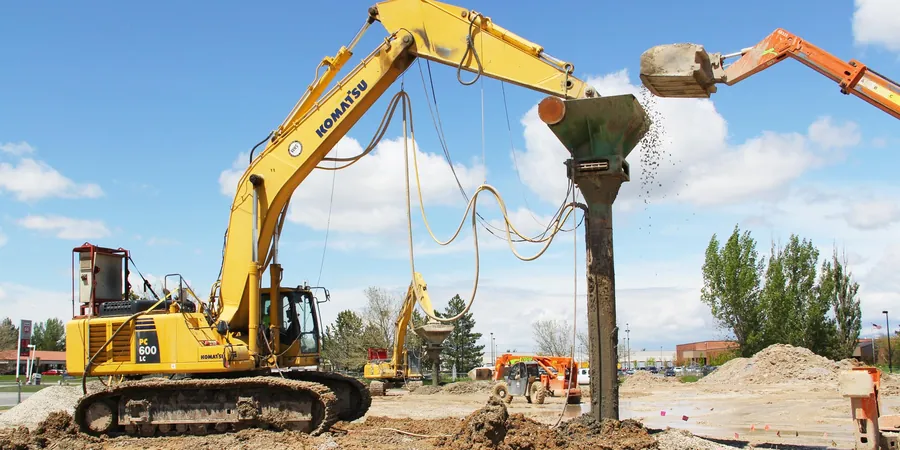
We still see it around Tulsa: a site pad compacted with standard fill methods, then three years later the slab shows differential settlement near the creek alignment. The problem usually starts in the design phase—assuming a uniform Proctor density target for soil that hasn’t been profiled correctly. Vibrocompaction design is not plug-and-play. In the Arkansas River floodplain, where Holocene alluvium can reach 40 feet thick, grain-size distribution dictates vibro parameters. A poorly graded sand at 51st and Yale won’t respond the same as a silty sand near Mohawk Park. Before the vibroflot ever hits the ground, our lab runs full gradation suites and SPT correlations to define target relative density—typically 70 to 85 percent—and we cross-check that with grain-size analysis to ensure the soil matrix can actually transmit vibratory energy efficiently.
A single boring logged as ‘medium dense sand’ without gradation data tells you almost nothing about how that soil will respond to vibratory energy.
Methodology and scope
Local considerations
Two sites in Tulsa, three miles apart, can behave completely differently under vibratory loading. Soils along the Arkansas River corridor—think Riverside Drive to Sand Springs—are often clean, poorly graded sands that compact beautifully with vibroflotation. Move east toward the limestone residuum near 41st and Harvard, and you encounter stiff clays and weathered shale where vibrocompaction is useless; you’ll just churn the ground without densifying it. The biggest design risk is misclassifying the soil. If the exploration program only runs SPTs without grain-size curves, the designer can’t distinguish sand that compacts from sand that doesn’t. In Tulsa’s seismic design category, per ASCE 7-22, loose sands also carry a liquefaction potential that vibrocompaction can mitigate—but only if the gradation supports it.
Applicable standards
ASTM D1586-18 (SPT), ASTM D2487-17 (Unified Soil Classification), ASCE 7-22 (Seismic site class)
Associated technical services
Pre-Design Soil Characterization
Complete grain-size distribution curves per ASTM D422 and Atterberg limits per ASTM D4318, run on Shelby tube and split-spoon samples from the project site. We deliver a compaction feasibility assessment and recommended vibro parameters—probe type, grid spacing, lift schedule—before the contractor mobilizes.
Post-Compaction Verification Testing
SPT borings and cone penetration tests at the compacted site, comparing pre- and post-treatment blow counts. We provide relative density calculations and signed reports documenting compliance with the project’s performance specification.
Typical parameters
Frequently asked questions
What does vibrocompaction design cost for a typical Tulsa commercial site?
For a standard commercial pad under two acres in the Tulsa area, design-phase lab testing and vibro parameter specification typically runs between US$1,620 and US$5,640, depending on the number of borings and the suite of grain-size and SPT correlation tests required.
How deep can vibrocompaction work in the Arkansas River sands?
In the river alluvium common across Tulsa, vibrocompaction is effective to depths of 60 feet or more, provided the sand is clean and the water table is high enough to assist probe penetration. Our lab data from multiple Riverside Drive projects show consistent densification to 55 feet when the fines content stays below 12 percent.
How do you verify that the ground actually got denser after treatment?
We run pre- and post-treatment SPTs per ASTM D1586 at the same locations and depths. The comparison of N-values, converted to relative density, shows the improvement. For critical structures, we also run CPT soundings because they provide a continuous resistance profile with depth and eliminate the disturbance issues of split-spoon sampling.