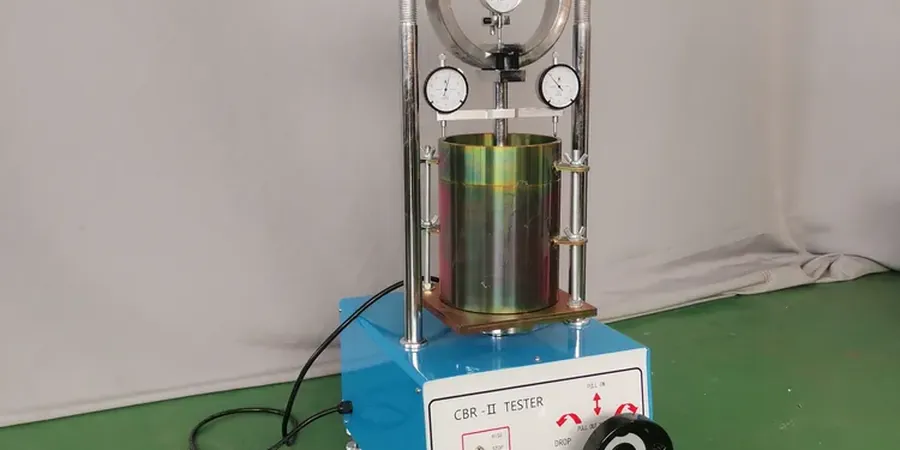
The loading piston advances at a constant 0.05 inches per minute into the compacted soil specimen inside the soaking tank. In Tulsa, where silty clays and weathered shale dominate the shallow geology, the laboratory CBR test remains the core empirical input for flexible pavement design. We run the procedure under AASHTO T-193 and ASTM D1883, submerging the specimen for 96 hours to replicate the worst-case moisture scenario that occurs in spring after heavy rainfall on the Arkansas River floodplain. The test measures the pressure required to push a standardized piston into the soil at two penetration depths, comparing the result against a crushed-stone reference. For municipal road projects in Tulsa County, this value directly determines the structural number and base-layer thickness, making it a cost-critical parameter before asphalt placement begins. Complementing the CBR with a Proctor test establishes the compaction target, while grain-size analysis confirms whether the material classifies as A-6 or A-7-6 under the AASHTO system.
Soaked CBR values below 3 percent in Tulsa subgrades typically require chemical stabilization or a thicker aggregate base, no matter what the dry CBR suggests.
Methodology and scope
Local considerations
Tulsa sits at approximately 220 meters above sea level, straddling the Arkansas River with broad terraces of alluvial clay that can lose over 60 percent of their bearing capacity when saturated. Pavement engineers designing for the city's expanding suburban grid, particularly around the rapidly developing areas south of Jenks and west toward Sapulpa, face a genuine geotechnical challenge: subgrade soils that test adequately in dry August conditions fail catastrophically during March construction when water tables rise. A CBR value of 2 or 3 soaked, where the dry test showed 8 or 10, forces a complete redesign of the pavement structural section. The IBC-referenced pavement design methodology demands the soaked CBR as the design input, not the dry value, and the City of Tulsa Public Works Department reviews subgrade reports with this expectation. Ignoring the moisture sensitivity of Tulsa clay leads to under-designed pavements that rut within the first two years, generating warranty claims and expensive mill-and-overlay repairs. We have seen parking lots in the Tulsa Hills area develop 40-millimeter depressions in wheel paths after just one wet winter because the design relied on an unsoaked CBR from a preliminary investigation.
Applicable standards
AASHTO T-193: Standard Method of Test for CBR of Laboratory-Compacted Soils, ASTM D1883-21: Standard Test Method for CBR of Laboratory-Compacted Soils, ASTM D698 / D1557: Standard Test Methods for Laboratory Compaction Characteristics of Soil, AASHTO M 145: Classification of Soils and Soil-Aggregate Mixtures for Highway Construction Purposes, ASTM D2487-17: Standard Practice for Classification of Soils for Engineering Purposes (Unified Soil Classification System)
Associated technical services
Soaked Laboratory CBR with Swell Monitoring
Full AASHTO T-193 procedure including 96-hour water soak, continuous swell measurement via dial gauge, and load-penetration testing at 0.1-inch and 0.2-inch penetration. We deliver the corrected CBR value, stress-penetration curve, and moisture-density relationship in a single report suitable for City of Tulsa submittal.
Pavement Subgrade Characterization Package
Combined testing program for flexible pavement design: soaked CBR, Modified Proctor (ASTM D1557), Atterberg limits, and grain-size distribution. We provide the AASHTO soil classification and a design CBR recommendation for the structural section, accounting for seasonal moisture variation typical of Tulsa's floodplain and upland clay soils.
Typical parameters
Frequently asked questions
How much does a laboratory CBR test cost in Tulsa?
A single-point soaked CBR test with swell measurement runs between US$140 and US$210, depending on whether it's part of a larger geotechnical package or a standalone request. The price includes the Proctor compaction curve needed to prepare the specimen at the correct moisture and density.
Why does Tulsa require soaked CBR instead of dry CBR for pavement design?
Tulsa's subgrade soils, primarily lean clays (CL) and fat clays (CH) from the Pennsylvanian shale formations and Arkansas River alluvium, experience significant strength loss when wet. The soaked CBR replicates the moisture condition beneath an impermeable asphalt surface after seasonal groundwater rise, providing a conservative design value that prevents premature rutting.
What soil classification corresponds to low CBR values in the Tulsa area?
Soaked CBR values below 3 are typical for A-7-6 soils (high-plasticity clays) found on the Arkansas River floodplain. These materials have liquid limits above 50 and plasticity indices exceeding 30. A-6 soils on upland terraces generally yield CBR between 4 and 8 soaked, depending on compaction effort and moisture content at placement.
Can the laboratory CBR test be run on aggregate base material?
Yes, but the standard 6-inch mold limits particle size to 3/4 inch maximum. For Oklahoma Department of Transportation Type A aggregate base with larger particles, we follow the modified procedure using scalped material or recommend complementary resilient modulus testing. The soaked CBR on base course typically exceeds 30 percent and is used to verify the structural layer coefficient.