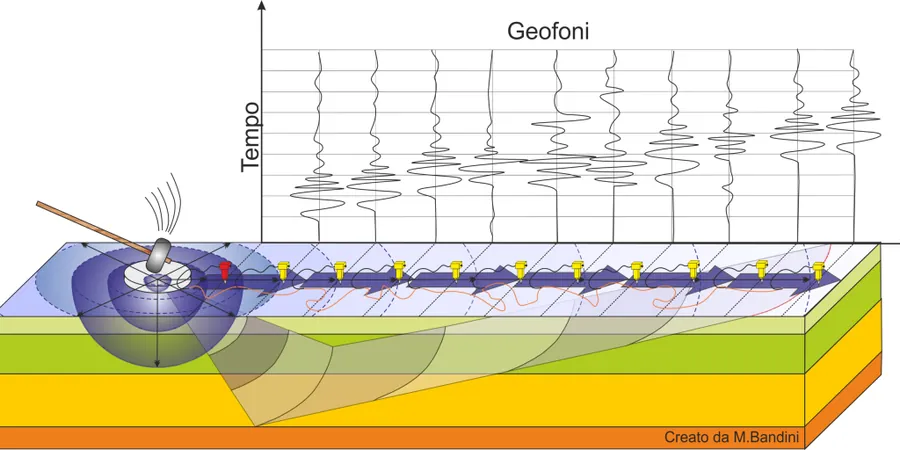
Tulsa sits on a mix of Arkansas River terrace deposits and Pennsylvanian shale and sandstone formations that don't always behave predictably. We regularly see 30-meter shear wave velocity profiles shift by 200 m/s between a site near the river and one up in the Osage Hills. That difference matters for your Site Class determination. Our lab team runs surface-wave acquisition with 24-channel seismographs, processing dispersion curves in-house to extract a reliable Vs profile. We cross-check the results against nearby boring logs because a seismic refraction line or a few SPT borings often catch velocity inversions that a single geophysical method might miss.
Vs30 is not just a number for the permit office — it controls your seismic base shear and whether you trigger a site-specific response analysis.
Methodology and scope
Local considerations
Tulsa County sits within the Meers Fault influence zone and sees induced seismicity from deep injection wells, making site-specific Vs30 data far more relevant than generalized USGS proxy maps. The NEHRP hazard maps default to Site Class D at 760 m/s for much of the region, but our direct measurements commonly override that assumption, revealing softer profiles that amplify short-period spectral acceleration by 15-25 percent. Missing that amplification means underestimating the seismic demand on your lateral system. The Arkansas River corridor also presents a classic soft-soil basin effect: low-velocity sediments trap and amplify surface waves, extending the duration of strong shaking. Our team addresses this by delivering time histories and response spectra when the site class downgrades from the default.
Applicable standards
ASTM D4428/D4428M-14, ASCE 7-22 (Chapter 20), IBC 2021 (Section 1613), NEHRP Recommended Provisions
Associated technical services
MASW Surface Wave Survey
Active-source 24-channel survey with 4.5 Hz geophones. Includes dispersion curve extraction, inversion modeling, and a signed Vs30 report with Site Class per IBC 2021. We handle access constraints on creek lots and urban infill sites.
Downhole-PS Suspension Logging Cross-Check
For critical structures requiring redundancy, we run downhole PS velocity logging in a cased borehole and compare the interval velocities with the MASW inversion model to validate the profile.
Typical parameters
Frequently asked questions
How much does a standard MASW survey cost for a single-family lot in Tulsa?
For a typical residential lot survey within Tulsa County, the cost ranges from US$1,430 to US$3,580, depending on the array length needed to reach 30 meters and whether passive measurements are required.
How long does it take to get the final Vs30 report after the field test?
We typically deliver the processed Vs profile and Site Class letter within 3 to 4 business days. Rush processing is available if the driller is waiting on foundation recommendations.
Can MASW work on a site with buried utilities and asphalt pavement?
Yes, we deploy the spread on asphalt or compacted gravel without issue. We call OKIE811 before the survey and adjust the spread layout to avoid marked utility corridors, using shorter receiver spacing if needed.
What is the difference between MASW and a seismic refraction survey for site class?
Seismic refraction maps P-wave velocity layers and can miss low-velocity zones, whereas MASW directly measures shear wave velocity and captures velocity inversions. For IBC Site Class, MASW is the preferred primary method because Vs30 is the required parameter.