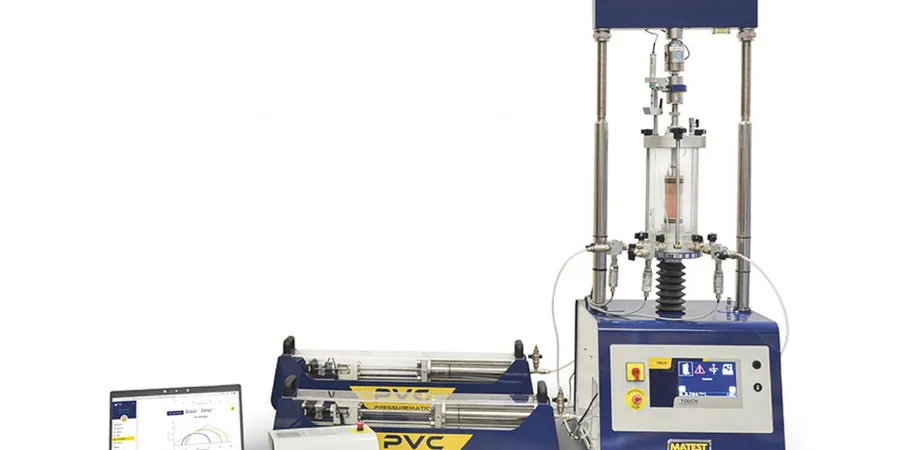
A triaxial cell sits inside a load frame at our lab, with a Tulsa soil specimen sealed inside a latex membrane and submerged in a pressure chamber. The cell applies confining stress while an axial piston shears the sample at a controlled strain rate. For local projects, the setup runs on a closed-loop servo controller that holds backpressure saturation until Skempton’s B-value exceeds 0.95. That level of saturation is critical when you are testing low-permeability clays from the Arkansas River floodplain or stiff shale from the Osage Hills. Without full saturation, effective stress paths drift and the friction angle you report to your structural engineer can be off by several degrees. We run drained, undrained, and unconsolidated-undrained protocols per ASTM D4767 and D2850, and every test includes a post-shear photo log so you can see the failure plane before you sign off on the bearing capacity. For deep excavations near the BOK Center, where groundwater is shallow, these parameters feed directly into the wall design and dewatering plan.
Effective friction angle from a properly saturated triaxial test is the single most important number in a Tulsa slope stability or retaining wall design.
Methodology and scope
Local considerations
Downtown Tulsa and the Cherry Street corridor sit on very different soil profiles, and that difference shows up sharply in triaxial results. Downtown, especially near the Williams Center, the subgrade is often stiff, overconsolidated lean clay and weathered shale with a peak phi' around 28 degrees and cohesion on the order of 500 psf. But move east to Cherry Street and you hit the river terrace deposits: softer, normally consolidated silty clay with Su values that can drop below 800 psf at a depth of 10 feet. If a structural engineer assumes downtown soil parameters for a Cherry Street project, the foundation design will be unconservative. We have seen this happen. The risk is not just bearing capacity failure. It is excessive differential settlement between columns founded on variable strata. A CU triaxial test with pore pressure measurement gives the undrained modulus Eu for immediate settlement analysis, and paired with consolidation data, it lets you estimate long-term settlement under sustained load. For projects near the Arkansas River levee system, we recommend at least one multi-stage CU test per boring to capture the strength envelope across the stress range of the proposed fill and structure.
Applicable standards
ASTM D4767-11, ASTM D2850-23, AASHTO T-296, USACE EM 1110-2-1906
Associated technical services
Consolidated-Undrained (CU) with pore pressure
Best for Tulsa floodplain clays where effective stress analysis controls the design. We consolidate to in-situ stress, saturate under backpressure, and shear undrained with pore pressure measurement. Output includes c' and phi' from Mohr-Coulomb envelopes.
Unconsolidated-Undrained (UU) for short-term stability
Quick, reliable undrained shear strength for temporary excavations and footing subgrades. We run these on Shelby tube samples the same day they arrive, minimizing moisture loss and disturbance effects.
Consolidated-Drained (CD) for long-term conditions
Slow shear rate with full pore pressure dissipation. We recommend CD tests for shale and stiff clay where drained strength governs the permanent condition, especially for cut slopes along I-44 and Highway 169.
Typical parameters
Frequently asked questions
How many triaxial tests do I need for a Tulsa commercial building site?
We typically recommend one CU test per major soil stratum encountered in the boring logs, with a minimum of three tests per site for a statistical strength envelope. For a two-story office building on the east side of Tulsa, a common program is two CU tests on the lean clay and one UU on the underlying shale to capture both undrained and drained behavior.
What is the cost for a triaxial testing program in Tulsa?
A standard program of three CU triaxial tests with pore pressure measurement runs between US$1,880 and US$2,420, depending on confining stress levels and whether we need to run multi-stage loading on a single specimen. We provide a fixed quote before you ship the Shelby tubes.
Can you test Tulsa shale in the triaxial cell without it falling apart?
Yes. We trim the specimen with a wire saw while the sample is still inside the Shelby tube liner, then immediately set it on the pedestal and apply a small seating load. For fissile shale from the Vamoosa Formation, we use filter-paper side drains to accelerate consolidation and prevent pore pressure buildup at the drainage boundary. A photo log before and after shearing documents any pre-existing fissures. More info.