A few years back, during the preliminary investigation for a detention basin on the Arkansas River floodplain west of downtown Tulsa, the contractor assumed the compacted shale would be practically watertight. They skipped the in-situ permeability tests. After the first major rain event, the side slopes started seeping within hours, and the project lost three months in emergency dewatering and redesign. That episode sums up why we never rely solely on lab permeameters when the stakes involve excavation stability or cutoff wall performance. In the layered alluvium and fractured shale that characterize so much of Tulsa's subsurface, a Lefranc test executed at multiple depths inside the borehole gives us a direct measurement of hydraulic conductivity that no remolded lab sample can replicate. For rock socket evaluations beneath the city's growing mid-rise sector, we pair it with the Lugeon test to quantify fracture flow under pressure, which is essential before committing to a grouting program or designing permanent dewatering systems.
In fractured shale like Tulsa's, a single Lugeon stage at one pressure tells you almost nothing. The relationship between flow and pressure across five stages is what reveals the true hydro-mechanical behavior of the rock mass.
Methodology and scope
Local considerations
Tulsa's geology has a peculiar trait that catches off-guard engineers who trained in coastal or glacial terrains: the shale bedrock weathers into a stiff, blocky clay that looks impermeable in a split-spoon sample but can transmit significant water through relic fractures and slickensided surfaces. We have measured Lugeon values exceeding 15 in rock that the driller's log described as competent. If a design team bases its dewatering plan on assumed low permeability without verifying it in the field, the excavation turns into a sump the moment it cuts through the weathered zone. The cost overruns on a single flooded excavation in the Pearl District could easily surpass the price of a dedicated field permeability testing program. Beyond the construction-phase risk, there is a long-term performance issue: leaking underground structures in low-permeability soils can develop hydrostatic pressures that compromise slabs and walls. A properly executed Lugeon or Lefranc test gives the structural engineer the real numbers needed to design relief drains or waterproofing systems that actually work for Tulsa's seasonal groundwater fluctuations, which typically peak between March and May.
Applicable standards
ASTM D6391-11 (Standard Test Method for Field Measurement of Hydraulic Conductivity Using Borehole Infiltration), Houlsby A.C. (1976) Routine Interpretation of the Lugeon Water-Test, USBR Earth Manual Part II — Water Testing in Drill Holes
Associated technical services
Lefranc Variable-Head Testing in Soils
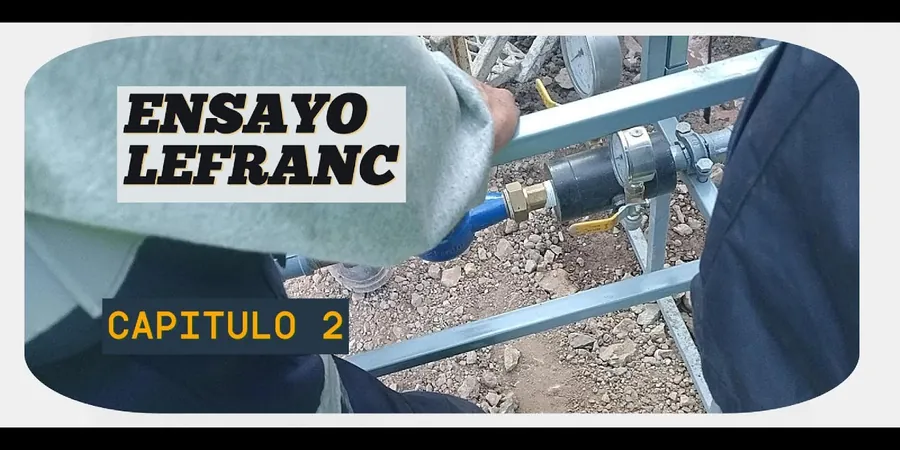
We perform falling-head and constant-head Lefranc tests in soil boreholes to determine hydraulic conductivity in alluvial sands, residual clays, and compacted fills. Each test includes water level monitoring with an electronic dip meter and redundant manual checks.
Lugeon Pressure Testing in Rock
Our crews run multi-stage Lugeon tests in fractured shale, sandstone, and limestone using single or double packer configurations. We analyze the pressure-flow curves to distinguish laminar flow from fracture dilation or erosion, providing a Lugeon value that directly informs grouting and drainage design.
Combined SPT and Permeability Profiling
For projects that need both strength and hydraulic data, we integrate standard penetration testing with targeted permeability tests in the same borehole. This saves mobilization costs and produces a continuous profile of both mechanical and hydraulic properties.
Typical parameters
Frequently asked questions
When should I choose a Lugeon test instead of a Lefranc test in Tulsa?
The choice depends entirely on the material at the test depth. Use a Lefranc test in soil or highly weathered rock where the borehole wall stands open and you can isolate a granular zone. Switch to a Lugeon test once you hit competent rock — typically the shale or limestone bedrock that underlies most of Tulsa at depths between 15 and 40 feet. The Lugeon test uses a packer to seal off a section of the rock interval and applies controlled water pressure, which is the only reliable way to measure fracture-controlled permeability. In many Tulsa projects we run both methods in the same borehole: Lefranc in the overburden, Lugeon in the bedrock.
How much does a field permeability test cost in the Tulsa area?
A single Lefranc or Lugeon test, including packer setup, pressure stages, and data interpretation, typically falls in the range of US$570 to US$1,080 per test interval. The exact price depends on the number of intervals tested per borehole, the depth of the hole, and whether we are combining the permeability test with other in-situ tests like SPT sampling or MASW geophysics during the same mobilization.
What Lugeon value would indicate that grouting is necessary for a dam foundation?
A common threshold in dam engineering, and one we reference in Tulsa's watershed projects, is that rock with a Lugeon value above 3 to 5 Lu generally requires grouting to reduce seepage to acceptable levels. However, the decision also depends on the reservoir head, the width of the foundation, and the consequence of seepage. For small flood-control dams on tributaries like Mingo Creek, we might accept up to 7 Lu if the seepage path is long. For a water supply reservoir with a constant high head, even 2 Lu can justify a systematic grouting program.